

The Curse of Knowledge: When Your Company Briefs and Announcements Make Perfect Sense to You — and No One Else
Updated: Aug 31

You sent the strategy update. It was clear. You'd read it four times, had two people review it. And then someone came back with a question that told you they'd understood almost none of it.
My six-year-old niece is lying face down on the floor, completely still. We're playing charades. The timer ran out two minutes ago. Her sister is losing patience. We keep guessing — aeroplane? Chocolate bar? Phone? — throwing out random words like we're bidding at an auction nobody told us we'd entered.
Eventually she gets up laughing and flips the card over.
Ironing board.
And suddenly it all makes sense — the stillness, the outstretched arms. But in the moment, what was completely obvious to her was invisible to the rest of us. She couldn't understand why we weren't getting it. We couldn't understand what she was doing.
That's the Curse of Knowledge. The more you know about something, the harder it becomes to imagine what it's like not to know it. Once a thing is obvious to you, you lose access to what it felt like before it was obvious — and with it, your ability to picture the person hearing it for the first time.
Authors Chip and Dan Heath, in their book Made to Stick, described the curse of knowledge as "Once we know something, we find it hard to imagine what it was like not to know it. Our knowledge has 'cursed' us. And it becomes difficult for us to share our knowledge with others because we can’t readily re-create our listeners’ state of mind."
The experiment that should worry every comms writer
In 1990, Stanford researcher Elizabeth Newton ran a now-famous study. She divided participants into two groups: tappers and listeners. Tappers were asked to tap the rhythm of a well-known song on a table. Listeners had to identify it from the tapping alone.
The Tappers predicted listeners would guess correctly 50% of the time.
The actual success result was 2.5%, just 1 in 40 songs was correctly identified.
The reason: When tappers tapped, they could hear the full melody playing in their heads. They could not imagine what the tapping sounded like to someone who couldn't.
In every messaging brief, every internal announcement, every carefully composed update, the people doing the writing are just like the tappers.
And the people they're writing for are the listeners.
When the framework is obvious to you, and to no one else
In May 2026, Cloudflare cut around 1,100 jobs — roughly a fifth of the company — just days after posting record quarterly revenue. CEO Matthew Prince explained the logic in a memo, then expanded on it in a Wall Street Journal op-ed: every role at the company sorted into three categories — builders, sellers, and measurers — with AI expected to replace most of the measurers.
Inside Prince's head, this was a tidy piece of strategic reasoning, borrowed from a management framework he clearly respected. But the employees reading it didn't have access to that internal scaffolding. They just saw themselves sorted into a category, and then watched that category get eliminated.
Venture capitalist Chamath Palihapitiya put it bluntly on the All-In podcast: Prince had reduced people to a label, then laid off the label. For anyone job-hunting afterward, "measurer" wasn't a strategic framework. It was a scarlet letter.
That's the Curse of Knowledge at company-wide scale. Prince wasn't careless, and the framework wasn't stupid — it's the same gap as the tapping study, just with a lot more at stake. He could hear the full argument in his head. His employees could only hear the tapping.
The everyday version of this is smaller, but it's the same mechanism.
Why company-wide briefs are especially vulnerable to the curse of knowledge
Company briefs and announcements are written by the people closest to the work: comms leads who have been in every strategy meeting, department heads who authored the initiative, HR business partners briefed within an inch of their lives. These are, without exception, the people most at risk of the Curse of Knowledge.
The cruelest part of the curse is that it is invisible to the person it has cursed. You don't notice the moment your brief stops making sense to someone reading it fresh. You just keep writing, confident, clear in your own head, and completely unaware that you left your audience behind three paragraphs ago.
The feedback rarely makes it back to you. Employees don't reply to the all-hands email to say they had no idea what it meant. They don't raise their hand in the town hall to admit they're confused. They do something quieter and more damaging: they disengage. They scroll past, or they forward it to a colleague, hoping someone else will translate it for them. Or worse, they fill the gap themselves, with assumptions that end up entirely wrong.
Three ways the curse shows up in briefs
The jargon trap. When you've spent months inside a project, the language of that project becomes your native tongue. Phrases like "the new TOM will be rolled out following Phase 2 of the workstream" are complete sentences to you. To a significant portion of your organisation, they are locked doors with no handle.
The reader doesn't always know they're missing context, sometimes they assume the confusion is their fault, that they missed the email where it was explained. So they don't ask. Over time, jargon doesn't just confuse people. It signals the brief wasn't written for them.
The slow erosion of trust. One bad brief won't break trust. A pattern of them will. Once employees decide your updates are written for leadership and not for them, even your best briefs fight an uphill battle to be read fairly.
Four ways to break the curse
1. Use plain language, and the words your team already uses. Assume less rather than more. Split dense sentences — one idea each. And don't rename things: if your team calls it "the review process," don't suddenly call it "the performance calibration cycle" in the brief just because leadership does. The test: would a new joiner understand it on day one?
But what if you're talking to a technical team?
Now and then you will have to use a complex word and sometimes industry jargon is unavoidable — acronyms, product names, and methodology terms have legitimate places in internal communication. The rule is not to eliminate them but to never leave them unexplained for the first-time reader.
For example: Read the sentences and Answer: Where is the bird?
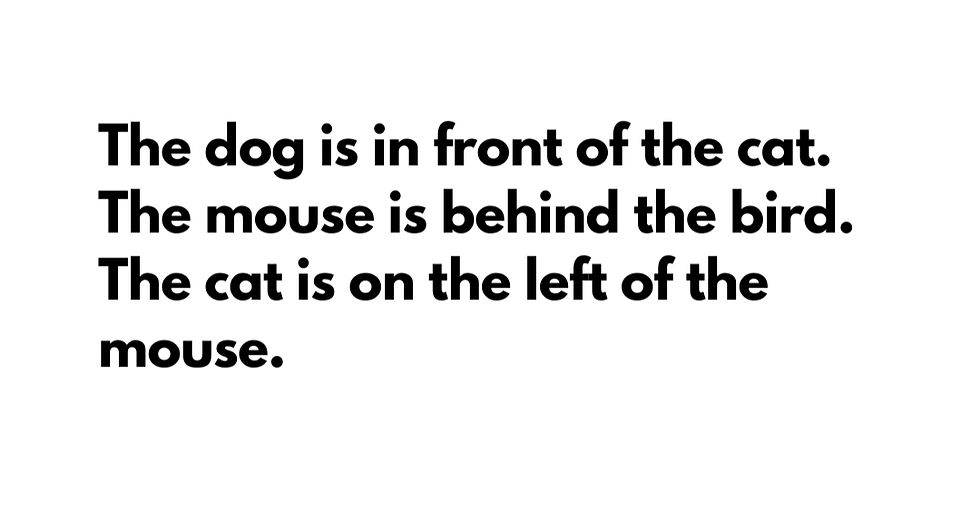
Did you have to go back and read it again?
That's because each sentence requires a new image, which makes your brain work harder to re-engage.
Now try it again with these sentences: Was it easier to find the bird?

Threading is when you thread your sentences together by connecting a new concept to an old one or one that your audience is already familiar with. It's a great way to explain something complex in a simple way.
For example:
"We're moving to an agile delivery model, a way of working in shorter, iterative cycles rather than long sequential projects, starting in Q3. Under this model, each team will work in two-week sprints, with a clear set of priorities agreed at the start of each cycle."
You haven't had to simplify the content; you're not dumbing it down. You're simply acknowledging that not everyone shares your starting point.
2. Lead with the "so what." Most briefs bury the point under background and history. Flip it. "From 1 May, the expenses process is changing — here's what you need to do differently" beats three paragraphs of Finance backstory before anything actionable appears.
3. Get specific. Vagueness reads as anxiety or evasion; specificity reads as credibility. "We're committed to an excellent employee experience" is noise. "Every employee gets a 30-minute monthly check-in, and IT requests are resolved within 48 hours" is a commitment.
4. Anchor abstractions in something familiar. Don't explain a new process in procedural terms — describe what a typical Monday looks like under it. One good analogy does more work than three paragraphs of explanation.
Two questions before your team hits send
Where are we assuming the reader already knows what we know?
Which terms or concepts might be too insider for our wider audience?
----------------
Messaging designed to survive the rooms you're not in
🎯 Hi, I'm Vivien,
I help global B2B communication leaders and teams design messaging that survives across stakeholders, buyers, and employees — so critical decisions move faster, updates don't get ignored, and your credibility stays intact.
Sending something with real stakes attached — a restructuring, a layoff, a strategy shift? Get Executive Comms support
Trying to fix the everyday drift — newsletters, updates, briefs that keep landing wrong? Build your Key Messaging Library
