

What Killed Meta's Memo Had Nothing To Do With The Memo,
Updated: Aug 17

The most expensive mistake in corporate communications is treating your audience like a blank page.
In November 2025, Meta sent its employees a carefully worded memo.
It said AI-driven impact would become part of how performance was evaluated and rewarded.
The tone was positive
It mentioned opportunity, not consequence
But employees still read it as a threat.
News articles reported it as a warning.
And trust walked out the door.

Your audience never reads your message in isolation
They read them through the lens of everything they already know, everything they've already felt, and everything they're afraid of.
That's the primary lens through which your messages are being interpreted.
By the time your words arrive, the environment has already been built.
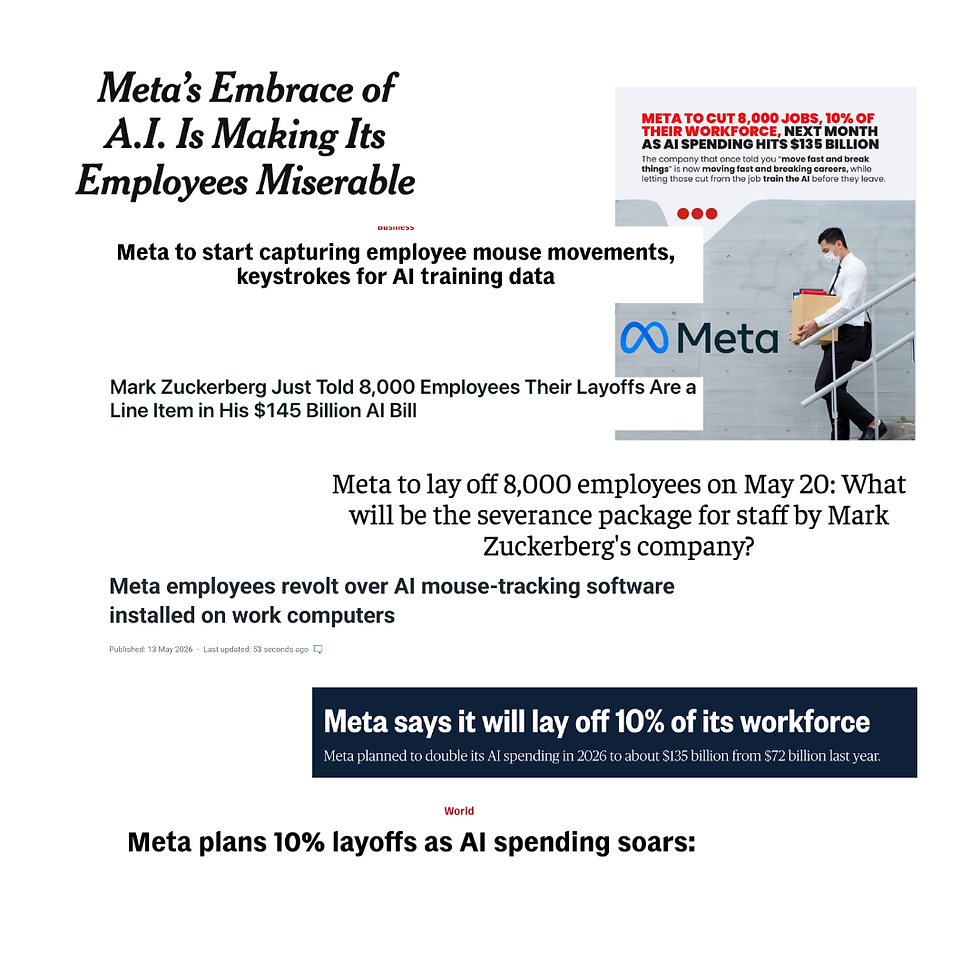
For Meta's employees, the ground had been shifting for months.
- multiple rounds of redundancies, a $135 billion infrastructure spend framed as the same efficiency story that had ended colleagues' jobs, a company that had told the market it intended to run leaner and had followed through every time.
Into that environment arrived the Nov 2025 memo about rewarding AI-driven impact with Meta's Head of People, Janelle Gale, writing: "As we move toward an AI-native future, we want to recognize people who are helping us get there faster. For 2025, we'll reward those who made exceptional AI-driven impact, either in their own work or by improving their team's performance."
Read in isolation, it's a reasonable message. It talks about reward, not punishment: opportunity, not consequence.
But nobody was reading it on its own. They were reading it inside months of job losses that had never been communicated in a way that built trust. So a message about rewarding AI-driven impact didn't land as recognition. It landed as a countdown.
One engineer put it plainly: "The company's idea is that you start using it first, and we'll see how well you do later."
The Part Of Communication Nobody Teaches You
Your Internal message environment is built from specific, traceable things: the last restructure and how it was handled, the promise leadership made six months ago and whether it was kept, the question that went unanswered at the last town hall, the rumour that circulated for three weeks before anyone confirmed it. All of it becomes accumulated context — the filter your audience runs every future message through.
Most leaders never account for this. They spend hours polishing word choice, tone, and sequence while the foundation underneath is already cracked. There's an entire industry built around writing better messages — storytelling workshops, structure frameworks, guides on clarity and brevity. Almost none of it asks about the environment the message is landing in.
Message survival isn't about making your communication bulletproof.
It's about understanding that your words will be stress-tested the moment they arrive — by context, by history, by the fears already present in the room. The communicators who get this right don't just write well. They read the environment first and ask: What world is this message landing in? What has already been decided before they read the first line? What does my audience already believe is true?"
Build The Environment Before You Need It
Every company eventually has a high-risk message to send: a restructure, a redundancy round, a strategic pivot. You don't build the environment for that message in the moment you need to send it. You build it in the eighteen months before.
Every communication you send is either a deposit into that account or a withdrawal from it. When the hard message finally arrives, the only question that matters is whether your account is in credit or overdrawn.
Here are 7 legal-friendly ways to build the environment so you always stay in credit and how to frame for what your audience already knows
Framing around context means entering the room your audience is already in, before you try to move them somewhere else.
1. Communicate the direction before you communicate the decision.
The most destabilising messages are the ones with no prior signal. Employees who've spent months hearing that the company is navigating change, that AI is shifting how work gets done, that leadership is thinking carefully about structure — those employees receive a restructure announcement differently to the ones for whom it arrives out of nowhere. You don't need to telegraph every decision. You need to be communicating direction consistently enough that decisions feel like the next logical step, not a shock.
2. Say what you don't know as often as you say what you do.
Most organisations stay silent until the picture is fully clear. That trains your audience to read silence as something being decided without me. You can't share what you don't know, but you can share the process: "We're working through the details of how this will be implemented and will update as decisions are confirmed." That single line tells people things are moving, that they'll be kept in the loop, and that silence between now and the next update isn't something to read into.

3. Follow through on small things to build credit for big ones.
Trust isn't built in the high-stakes moments — it's built in the ones that don't feel like anything. The all-hands where a leader answers the tough question directly instead of redirecting. The team update that says "we got this wrong." These accumulate into the frame your audience brings to everything you say next. An organisation with a track record of following through gets the benefit of the doubt when the hard message lands. One without it doesn't.
Map the environment before you build the message.
A message that ignores the existing environment tells your audience one of two things: leadership doesn't know what people are feeling, or it knows and doesn't care. Before you draft anything, answer this:
What has your audience lived through in the last six months?
What's been promised and not delivered?
What are people already concluding in the corridors that your message is about to land inside?
5. Acknowledge the room without naming every fear in it.
Legal will rarely approve language that names a specific fear or admits uncertainty about a live decision. What they will approve is one framing sentence that places the message inside its moment: "This sits inside a period of significant change for our organisation and our industry." That's not an admission, and it's not a liability. And it's the difference between a message that lands as aware and one that lands as tone-deaf.
For Gale's memo, that might have read: "We're sharing this update at a moment when our industry and our organisation are moving through significant change. AI is reshaping how work gets done across every function, and we're committed to making sure our people are positioned well inside that shift." Same message. Different frame. It tells the reader: the person who wrote this knows where you are.
It doesn't change the message.
It changes the frame the message arrives in.
It tells the reader: the person who wrote this knows where you are.
6. Answer the most obvious question before it forms.
Every significant message generates a predictable inference. For most organisations mid-transformation, that inference is some version of is this about replacing us? Legal won't let you answer that head-on, but they'll almost always approve a "what this means for you" section or a manager FAQ. Answer the question before it hardens into a conclusion, and your audience won't fill the gap with the worst available answer.
7. Test the language with a frontline manager before it goes out.
Internal messages drafted at leadership level tend to arrive in the language of the strategy deck, not the language of the people receiving them.
A frontline manager will tell you in thirty seconds whether your message matches the conversation their team is currently having. What does this mean for their role, their team, their Monday morning?
The Bottom Line: Your Audience Decided What Your High-Risk Message Meant Long Before You Sent It.
Your audience decided what your high-risk message meant long before you sent it. The organisations that communicate well under pressure aren't better writers — they understood, months earlier, that every message they sent was either building the environment the next one would survive in, or eroding it.
Building that environment takes two things. The first is a consistent messaging foundation, a key messaging library where every team and every layer of leadership is building the same context instead of pulling in different directions.
The second is an executional process for high-stakes communication that starts long before the high-risk memo does — built into your Executive Communications, so every piece of content lands with trust and clarity already in place.
Neither is a magic bullet for the moment; the hard message has to go out. Both are investments in making sure that when it does, the environment it lands in was built to receive it.
If you're worried that your communications are in a similar position, those are the two places I'd start. And I can help you there.
--------------
Messaging designed to survive the rooms you’re not in
I'm Vivien, I help global B2B communication leaders and teams design messaging that survives across stakeholders, buyers, and employees—so critical decisions move faster, updates don’t get ignored, and your credibility stays intact.
If you have an announcement you're wrestling with? I work with communications teams on exactly these high-risk multi-audience messaging moments.


